governed chat interface
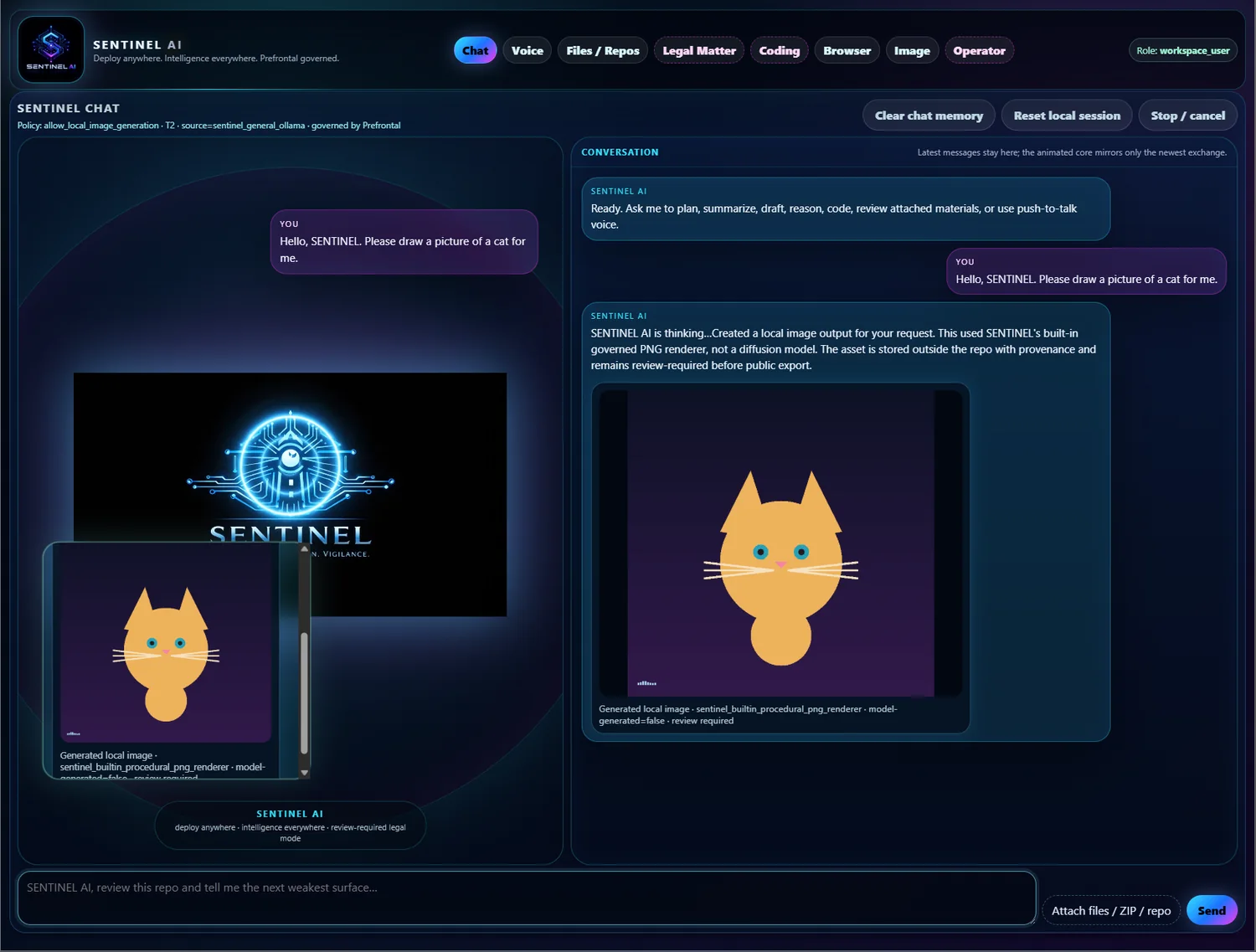
Full chat proof
Full SENTINEL AI workbench UI → governed route → generated image → provenance note → in-chat display.
route: image lanepolicy: recordedtrace: visible
 SENTINEL AI
TAHAI Web Services
SENTINEL AI
TAHAI Web Services
Local-first · governed · source-aware
A deploy-anywhere workbench for chat, files, legal research, coding, voice, browser-style workflows, and generated visuals — routed through Prefrontal Node so model choices, tools, memory, approvals, and evidence stay accountable.
Honest launch path
SENTINEL AI is being built in public. This site is the public product story and proof surface, not a hosted production app. The near-term focus is a reliable local Windows runtime, governed browser evidence, approved-folder file workflows, source-grounded answers, image provenance, and legal/coding review gates.
Five-second understanding
SENTINEL AI is the public platform experience: the place a user chats, attaches files, asks for legal research, requests a diagram, reviews a source, or approves an action. Prefrontal Node is the embeddable brain-sidecar underneath it: routing, policy, memory, tool control, approvals, and trace evidence. The adjacent coding app is becoming the build-and-verification lane in the same governed architecture.
Run locally, on a workstation, on a private server, on-prem, in cloud, or in restricted environments.
Every meaningful action can carry route, policy, source scope, approval state, and trace evidence.
Use approved folders, local documents, private sources, and reviewable retrieval without arbitrary device access.
Use local, hosted, open-weight, specialist, and challenger models through one governed routing layer.
Governed, not improvised
A request enters, gets classified, routes to the right lane, uses only allowed sources/tools, records evidence, and escalates sensitive actions for human review.
Prefrontal Nodeorchestrate · govern · traceSystem topology
Instead of forcing one model to do everything, SENTINEL can route work to specialist lanes while Prefrontal keeps the policy and evidence layer consistent.
More than a chatbot
Every capability is presented as governed work: visible sources, clear route labels, approval gates, and reviewable outputs where they matter.
Natural conversation, push-to-talk voice, interruptible responses, transcripts, runtime labels, and action cards.
Open laneApproved-folder workflows, large PDF handling, OCR, manifests, source anchors, split/rename review, and search.
Open laneMatter organization, authority lookup, timelines, citation checks, quote verification, drafts, and review-required exports.
Open laneRepo inspection, patch proposals, test plans, sandboxed commands, diff review, and protected-write approval gates.
Open laneScanned documents, screenshots, forms, image generation, editing workflows, asset metadata, and safety review.
Open lanePolicy, tenancy, approvals, trace evidence, source status, evals, release evidence, and model admission discipline.
Open laneRendered web access, search-provider smoke checks, screenshots, DOM extraction, source cards, and policy-gated web research.
Open lanePrimary product surface
SENTINEL is designed to show the work around the answer: source cards, route labels, policy state, approval cards, generated assets, and trace IDs. The user experience should feel powerful while still making the system accountable.
Local knowledge without unsafe access
SENTINEL is designed to work from explicit folder permissions and attachment flows. It can scan, parse, OCR, index, retrieve, and cite from approved sources while leaving original files untouched.
Digital Lawyer lane
SENTINEL can help organize matters, search authorities, map evidence, draft working language, and check citations. It is legal research and drafting assistance, not a substitute for a licensed attorney. Court-facing work requires human review.
Coding workbench bridge
The adjacent coding workbench is the verification lane: inspect a codebase, plan changes, generate a patch, run tests, review diffs, and carry evidence back into SENTINEL. The result is one architecture for research, drafting, coding, and operational work.
Build proof
Public proof should show capability, direction, and credibility — not private files, internal logs, or raw working notes.
What worked: generated asset displayed inside the conversation.
Why it matters: visual work can become governed, traceable, and reviewable.
What comes next: legal exhibits, diagrams, logos, and source-grounded visuals.
What worked: the product surface now shows conversational flow and asset display.
Why it matters: users need an approachable workbench, not an admin console.
What comes next: richer evidence rail, source cards, and approval cards.
What worked: the architecture is shaped around approved folders, manifests, OCR, and anchors.
Why it matters: private work becomes searchable without surrendering control.
What comes next: document splitting, organization, and source-grounded answers.
What worked: legal work is framed around source status, citation status, quote spans, and review.
Why it matters: trust comes from verification, not confident prose.
What comes next: stronger official-source ingestion and filing-readiness blockers.
Where SENTINEL is going
Progress is grouped by what is visible now, what is actively being connected, and where the larger architecture is headed.
Open ecosystem
SENTINEL is independent, but intentionally designed to integrate with open-source and public-interest software where licenses, security, and deployment policy allow.
Ollama, llama.cpp, vLLM, Text Embeddings Inference, Qdrant, ComfyUI, Diffusers, Axolotl, and candidate model families such as Qwen, Mistral, DeepSeek, BGE, E5/GTE, Nomic, Jina, and legal encoders.
View ecosystemCourtListener, RECAP, Caselaw Access Project, eyecite, reporters-db, courts-db, Juriscraper, GovInfo, Congress.gov, eCFR, Federal Register, Open States, Maine official sources, and other source-specific connectors.
View legal laneOpenTelemetry, Open Policy Agent, OpenFGA, Keycloak, Presidio, Syft, Trivy, Gitleaks, Cosign, SOPS, Vault-style key management, gVisor, Firecracker, Promptfoo, Ragas, and observability systems.
View trust centerTrust center preview
The public trust center explains data handling, security posture, responsible disclosure, third-party acknowledgments, and status language in plain English.